15
DecThe Guardians of the Tons Valley: Unveiling the Soul and History of Sankri
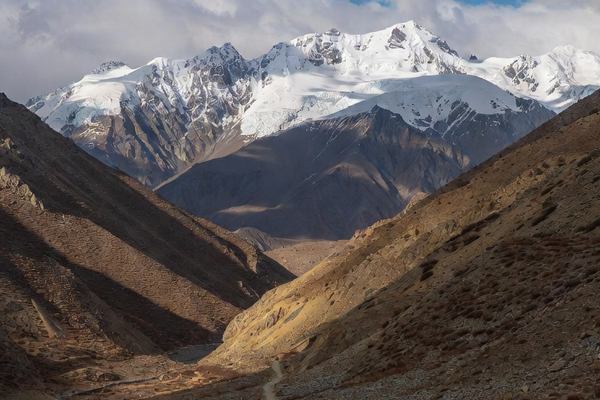
Nestled at an altitude of 1,950 meters in the Uttarkashi district, Sankri is often
dismissed as a mere "base camp." For most trekkers, it is the logistical pause before
conquering the #Kedarkantha summit or the gateway to the "Valley of Gods,"
HarKiDun.
However, as a traveler who has spent nights listening to the elders by the woodfire,
I’ve realized that Sankri is not just a starting point; it is a living museum of a
civilization that time almost forgot. This is the land of the Jaunsari and Rawat
communities, where history isn’t found in books, but in the intricate carvings of their
wooden temples and the fierce pride in their eyes.
The Mythological Roots: A History Painted in Grey
The history of Sankri and the surrounding villages like Osla and Jakhol is inextricably
linked to the Mahabharata. Unlike the rest of India, where the Pandavas are the
undisputed heroes, the upper reaches of the Tons Valley hold a fascinating, alternative
perspective.
The Cult of Duryodhana and Karna
Historically, the people of this belt were known as the followers of the Kauravas. Until
a few decades ago, several temples in the region were dedicated to Duryodhana.
• The Legend: Locals believe their ancestors fought alongside the Kauravas. To them,
Duryodhana was a just king who looked after his subjects.
• The Shift: In recent years, due to external cultural influences and a desire for
mainstream religious acceptance, many "Duryodhana" temples have been renamed as
"Someshwar Mahadev" (Lord Shiva). However, the rituals still carry the ancient
distinctiveness of their ancestral roots.
Trivia: In some remote pockets, the "Someshwar" idol is still carried in a
procession that mimics a king surveying his territory—a remnant of the regal status once
afforded to the Kaurava prince.
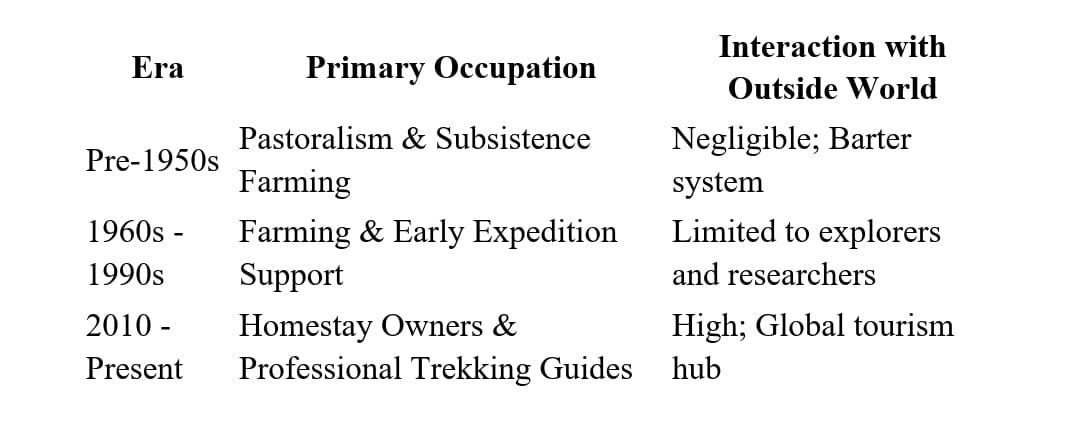
Socio-Economic Evolution: From Pastoralists to Trekking Pioneers
The history of the people is a story of adaptation. For centuries, the economy was
Transhumance (seasonal movement of livestock).
The Era of Sheep and Wool
Before #UttarakhandTravel became a global phenomenon, the people of Sankri were
primarily shepherds. They spent summers in the high-altitude meadows (Bugyals) like
Jumni and Maninda Tal, and winters in the lower valleys.
Their wealth was measured in sheep, and their clothing was hand-spun wool (Pankhi).
The Mountaineering Shift
The 1950s and 60s saw the arrival of explorers like Jack Gibson, who popularized the
#HarKiDun trek. The local men, with their innate knowledge of the rugged terrain and the
unpredictable weather of #BorasuPass, transitioned from shepherds to some of India’s
finest high-altitude guides.
Architecture: The 'Koti Banal' Style
If you look closely at the old houses in Sankri, you are looking at an ancient
engineering marvel called Koti Banal.
This indigenous architectural style has allowed these wooden structures to stand tall
for over 800 years, surviving massive earthquakes.
• Material: Deodar wood and stone.
• Design: Deep foundations and a layout that uses the wood's elasticity to absorb
seismic shocks.
• Aesthetics: The balconies are adorned with carvings of birds, lotuses, and geometric
patterns—symbols of the local #Pahari identity.
The Belief System: Where Faith Meets the Forest
The spiritual life in Sankri is governed by the Village Deity (Gram Devta).
This is not a distant concept; the God is a physical presence who decides on village
disputes, marriage dates, and crop harvests.
The "Pashwa" or the Oracle
The most intriguing part of their belief system is the Pashwa. During festivals, the deity is believed to enter the body of a chosen local man (the Pashwa). In this trance-like state, he performs dances and provides solutions to the villagers' problems.
This is a raw, visceral form of faith that bridges the gap between the human and the divine.
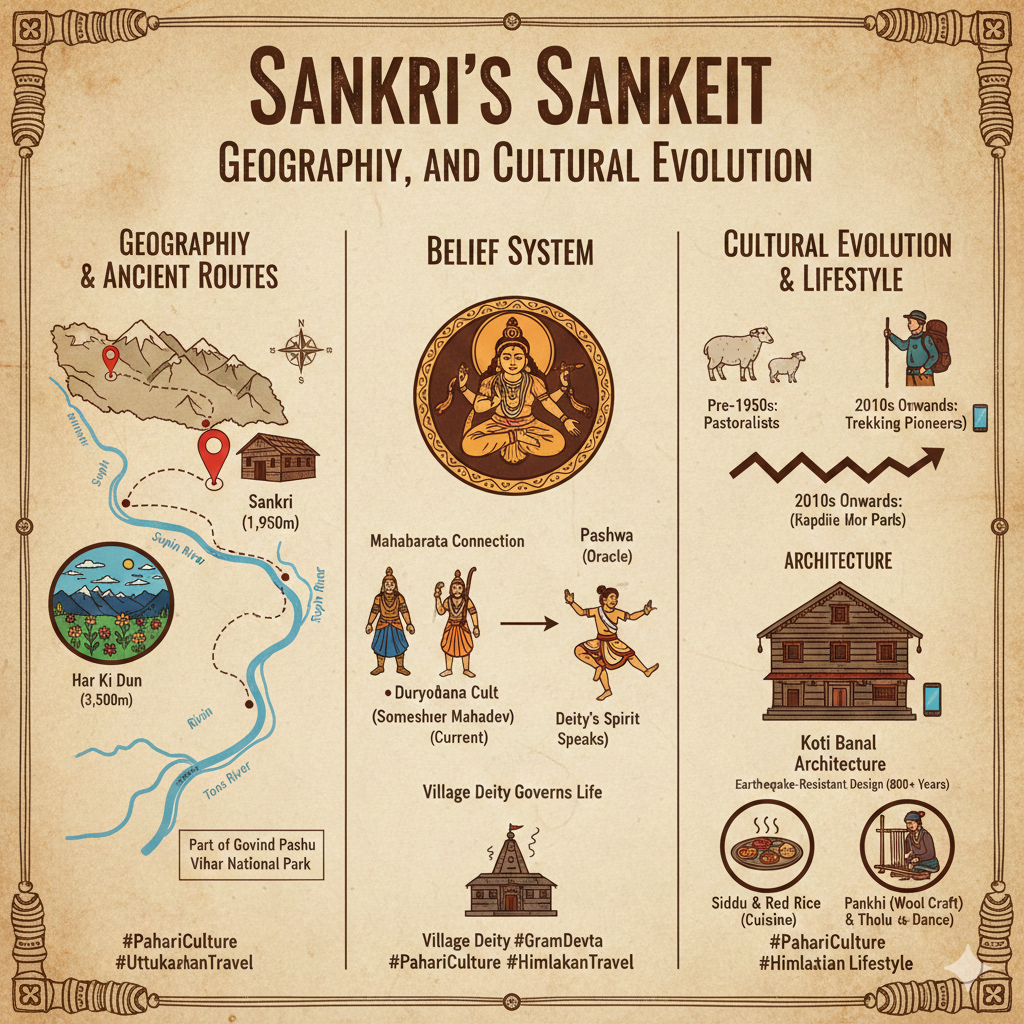
Infographic: The Cultural Fabric of Sankri
Challenges and the Modern Identity
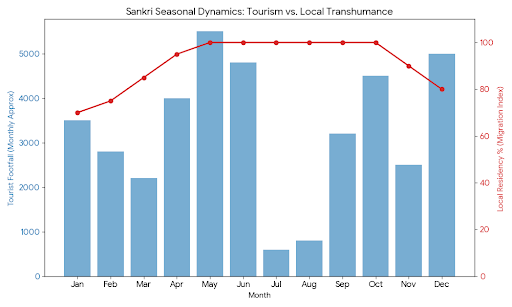
The transition from a secluded mountain hamlet to a bustling base camp has been a
double-edged sword. While the road connectivity from Dehradun and Mussourie has
brought prosperity, it has also put pressure on the fragile ecosystem.
The youth of Sankri today are tech-savvy, running Instagram pages for their
homestays, yet they remain deeply rooted. On a trek to #Kedarkantha, your guide might be
using a GPS, but he will still stop to offer a prayer at the small stone shrine of the
forest goddess, seeking permission to pass.
The Traveler's Perception: Why it Matters
When you walk through the narrow lanes of Sankri, past the children playing with wooden
tires and the women carrying stacks of firewood, you realize that the "history" of this
place is not a dead subject. It is active.
It is in the taste of the Red Rice grown in the fields of Govind Pashu Vihar. It is
in the rhythm of the Tandi dance. As a traveler, knowing the history of the Kaurava
connection or the Koti Banal architecture changes your perspective. You aren't just
visiting a scenic spot; you are stepping into a sacred geography.
Conclusion
Sankri is a testament to the resilience of the Himalayan people. From being the outcasts
of the Mahabharata to becoming the welcoming hosts of the Indian trekking community,
their journey is as steep and rewarding as the climb to Kedarkantha .
Next time you find yourself at a homestay in Sankri, look past the trekking maps. Ask
about the old gods, touch the ancient wood of the temples, and listen to the wind—it
carries stories that are thousands of years old.

Ambika Sarkar
A mountain lover who loves to explore and document it through words.
